Whole House Air Filtration in Columbia, PA

Advance Haws helps homeowners in Columbia, PA, improve their indoor air quality with whole-house air filtration. Our systems capture dust, pollen, allergens, and other pollutants, integrating seamlessly with your existing HVAC setup. We offer a range of options, including HEPA filters, bypass units, and UV treatments. Proper sizing, professional installation, and regular maintenance are key to ensuring effective airflow, energy efficiency, and system longevity. Homeowners can expect improved comfort, reduced allergens, and fewer maintenance issues. Advance Haws also provides guidance on warranties, local service support, and seasonal care to keep your system performing optimally year-round.
-min.webp)
Whole House Air Filtration in Columbia, PA
Clean indoor air is essential for comfort and health in Columbia, PA homes. Between humid summers, high seasonal pollen, agricultural dust from nearby fields, and wood smoke in colder months, many households benefit from a whole house air filtration system that works through the home’s HVAC system. This page explains system types, how they integrate with existing equipment, sizing and selection guidance, installation and maintenance expectations, performance metrics, energy and cost tradeoffs, and what local homeowners can expect before and after installation.
Why whole house air filtration matters in Columbia, PA
Local climate and lifestyle factors drive indoor air concerns in Columbia, PA. Spring and early summer bring tree and grass pollen; summer humidity increases mold and dust mite activity; and winter burning of wood or coal in some properties adds fine particulates. Older homes with less-tight envelopes can pull in outdoor dust and allergens more easily. A properly designed whole house system reduces airborne particles throughout every room by treating air centrally rather than relying on individual room purifiers.
Common whole house air filtration issues in Columbia homes
- Seasonal allergy triggers: pollen and mold spores that enter through ventilation and open windows.
- Fine particulate matter: PM2.5 from wood smoke or traffic.
- Household dust and pet dander that recirculate through HVAC.
- Odors and volatile organic compounds (VOCs) from household products (needs combined filtration and ventilation strategy).
- Systems underperforming because filters are undersized or incompatible with HVAC blower capacity.
System types and how they perform
- Media filters (high-MERV): Dense pleated filters installed in the return plenum. They capture a wide range of particle sizes and are available in MERV ratings up to MERV 16. Good balance of efficiency and integration with standard HVAC systems when matched correctly.
- HEPA whole-house solutions: True HEPA captures 99.97% of particles down to 0.3 microns. In whole-home applications HEPA is often installed in a dedicated bypass or a separate ducted unit to avoid excessive pressure drop through the furnace or air handler.
- Electrostatic precipitators: Use a charged grid to collect particles on plates. They can capture small particles effectively and are reusable, but require periodic cleaning and do not remove gases. Some designs produce low amounts of ozone, so choose certified models.
- UV-assisted systems: Ultraviolet lamps are added to kill biological growth on coils and in the airstream. UV reduces microbial activity and complements particle filtration, but by itself it does not remove dust or particulates.
How whole house filtration integrates with existing HVAC
Whole house units are typically installed at the return air or inside the air handler. Key considerations:
- Compatibility with blower capacity and static pressure limits to avoid reducing airflow.
- Location: filters commonly mount in the return plenum, filter cabinet, or a dedicated bypass module for HEPA.
- Ductwork condition: sealed, insulated ducts increase performance; leaky ducts reduce effective air changes.
- Controls: integration with the furnace fan or dedicated run cycles to achieve desired air changes per hour.
A professional assessment measures system airflow (CFM) and static pressure to select a filter that balances efficiency and acceptable pressure drop.
Sizing and selection guidance
- Determine home volume and HVAC airflow. Most sizing starts with the system’s CFM and desired air changes per hour (ACH).
- For allergy or health-sensitive homes, aim for higher efficiency (MERV 13 or HEPA via bypass). For general dust reduction, MERV 8 to 11 is commonly sufficient.
- Consider staged approaches: a washable or coarse prefilter to protect a high-efficiency media or HEPA stage reduces maintenance and cost.
- Factor in existing duct layout and available space for filter cabinets or dedicated units.
Installation process (what to expect)
- Initial assessment: HVAC inspection, airflow and static pressure measurements, and ductwork evaluation.
- Equipment selection: choosing media size, MERV level, or bypass HEPA unit based on measurements and homeowner priorities.
- Installation steps: mounting filter cabinet or unit, sealing connections, integrating controls, and verifying airflow.
- Commissioning: testing pressure drop across filters, verifying airflow (CFM), and running initial baseline air readings if requested.
Typical installs take a few hours to a day depending on complexity and if duct modifications are necessary.
Maintenance and filter replacement schedules
- High-MERV media filters: inspect every 3 months; replacement frequency commonly 3 to 12 months depending on load (household pets, smoking, seasonal pollen).
- HEPA units: HEPA cartridges often replaced every 1 to 3 years depending on loading; prefilters require more frequent change.
- Electrostatic units: washable collection plates need regular cleaning per manufacturer guidance, typically every 1 to 3 months.
- UV lamps: replace annually or per lamp rating to maintain effectiveness.
- Ongoing checks: measure static pressure annually and confirm airflow to ensure system continues to perform as designed.
Performance metrics and realistic expectations
- MERV ratings describe particle capture efficiency across size ranges; higher MERV traps smaller particles but can increase pressure drop.
- HEPA standard captures 99.97% of particles at 0.3 microns when air passes through the HEPA media as designed.
- Clean Air Delivery Rate (CADR) and air changes per hour (ACH) are useful for estimating how quickly a system clears particles from the home.
- Realistic outcomes: homeowners should expect a significant reduction in visible dust, lower levels of pollen and pet dander in filtered air, and measurable reductions in fine particulates when systems are properly sized and maintained. Complete elimination of all indoor pollutants is not realistic; filtration works best combined with source control and proper ventilation.
Energy and cost considerations
- Higher-efficiency filters increase pressure drop and can raise fan energy use; on some systems, the blower may need to run longer or be upgraded.
- Balance efficiency with operating cost: using a prefilter to protect a higher-efficiency stage reduces frequency of expensive replacements.
- Consider long-term maintenance costs and any potential HVAC adjustments needed to maintain heating and cooling performance.
Warranties, financing, and local service support
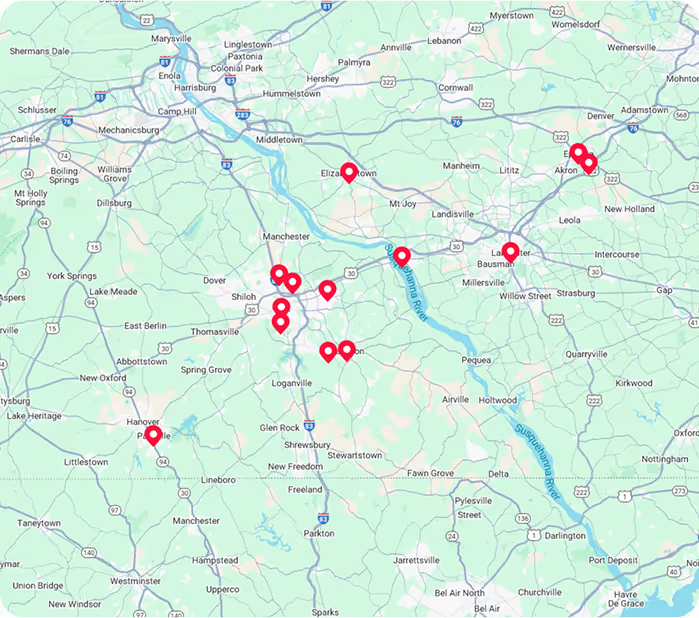
Many whole-house filtration components carry manufacturer warranties on the unit and lamps, and filters have standard replacement recommendations. Financing options and warranty terms vary by equipment and installer. Local HVAC professionals in Lancaster County and Columbia, PA are familiar with common regional issues such as seasonal pollen loads, humid summers, and older home duct systems; working with technicians experienced in local climate and building stock helps ensure proper system selection and long-term support.
Bottom line and seasonal maintenance tips
A properly selected and installed whole house air filtration system delivers consistent, homewide air quality improvements that room units cannot match. For Columbia homes, choose equipment with sufficient capacity for seasonal pollen and humidity impacts, include a staged filter approach to manage operating cost, and schedule annual checks to preserve performance. Regular prefilter changes and annual inspections keep pressure drop low and extend the life of higher-efficiency media or HEPA components, ensuring you get the air quality benefits expected from a whole house system.
Customer Testimonials
Focus on enhancing the quality of your maintenance plan by ensuring all components are well-coordinated and efficient. This will lead to improved performance and longevity of your systems.